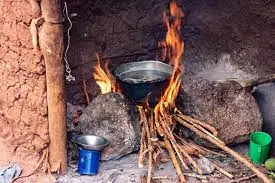
In earlier years, the idea was raised of doing something about smoke in Maasai huts. Cooking is traditionally done on three stones, on which a pan can be placed. Underneath is an open wood fire. This produces a huge amount of smoke, and because cooking is done indoors, the smoke stays in the hut. As a result, many people suffer from lung complaints. Smoke is very unhealthy, but the Maasai do not seem to be aware of this. Cutting down trees also takes a toll on the environment.
For the foundation, this was reason enough to give it attention. In the past we looked at a solution using a cooker that burns biomass far more efficiently than an open fire, where a lot of heat is lost and wood burns up relatively quickly because oxygen reaches the fire from all sides. There is a local foundation with a project in the Arusha area, but unfortunately it cannot expand into the outlying areas.
We looked at:
– chimneys (a pilot with two huts), which would only reduce the smoke problem; because of the way the roofs are built, fitting a chimney turns out to be particularly difficult. If a hole is sawn, the structure appears to be weakened so much that doing this on existing huts does not seem feasible.
– the costs and possibilities of making pellets ourselves and importing cookers; this turned out to be much more complicated than it seems and a full-time job. So we decided against it. This also had to do with the large number of cookers that would have to be purchased. This did not prove to be a feasible project for our foundation.
– options for solar cookers, but of course these can only be used during the day. Existing cookers are expensive. There have been projects in the past making solar cookers, but the cookers seem to have faded from view somewhat. There is probably a reason for that, and the energy and costs this project would require do not seem worth it, given that solar cookers have existed for a very long time and apparently do not bring the desired success.
A donation has already been received for this project, so the foundation aims to draw up a concrete plan this year that we can actually get to work on. The donor was asked whether the amount could be spent in a different way, and agreed.
All the research that has been done shows that a problem like this is hard to solve if it cannot be tackled on a large scale. Each time a new bottleneck appeared, which has led our foundation to let go of this problem.